
The UK just legalized balcony solar — what it means for the US
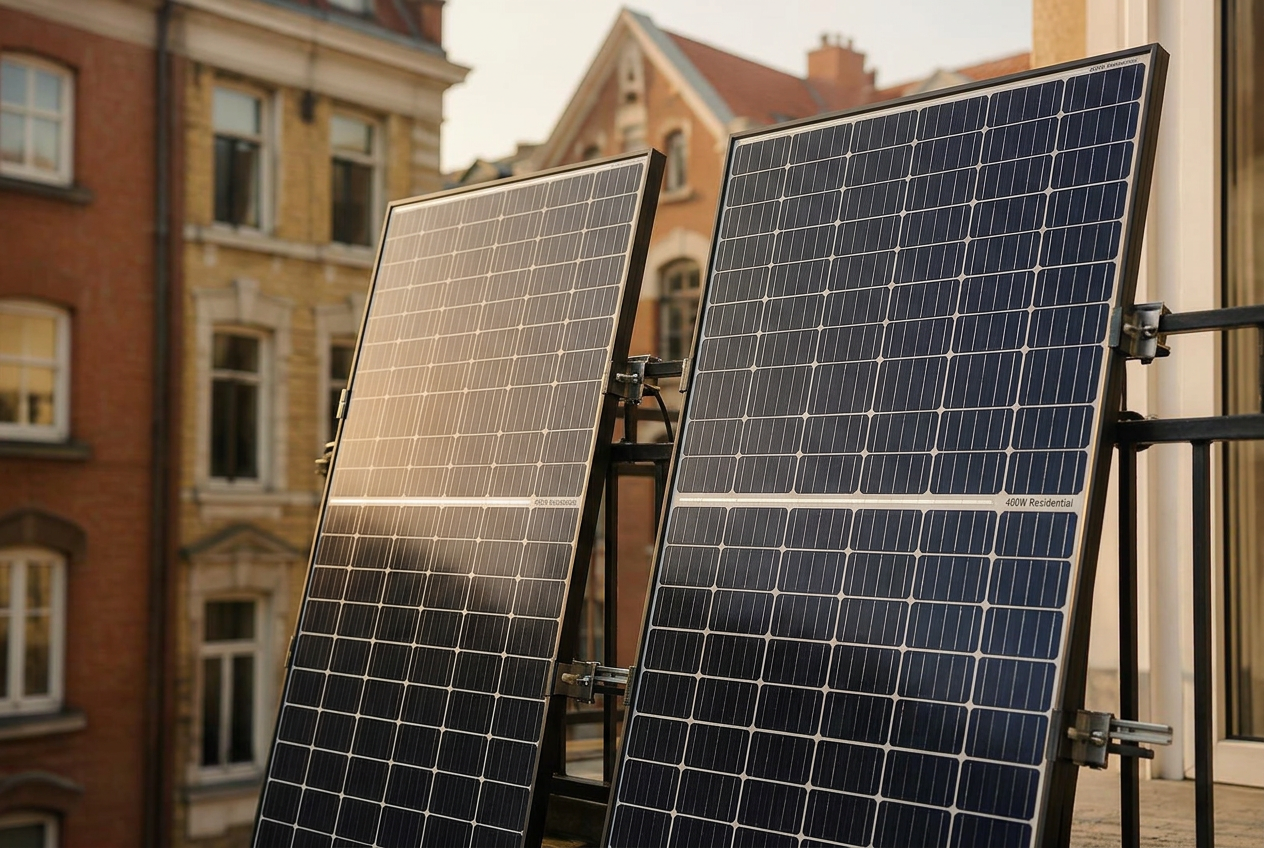
On August 27, 2026, it becomes legal for households across the United Kingdom to buy a plug-in solar system, hang it on a balcony railing or garden fence, and plug it into an ordinary wall socket. No installer. No planning permission. No five-figure quote. The change arrives through Statutory Instrument 2026/848, made on July 16 and laid before Parliament the following day, which amends two long-standing rules — the Plugs and Sockets etc. (Safety) Regulations 1994 and the Electricity Safety, Quality and Continuity Regulations 2002 — that had effectively made plugging a generator into a socket unlawful.
That matters to an American reader for one reason: the UK is the last major English-speaking market to take a question the US is currently answering state by state and settle it nationally, in a single stroke. Continental Europe worked through this years ago and has the adoption data to show what happens next. Understanding both gives you a much clearer picture of where plug-in solar in the US is actually heading — and what is still genuinely different here.
What the UK actually changed
The UK did not simply declare plug-in solar legal and walk away. Alongside the regulatory amendment, the Department for Energy Security and Net Zero published an Interim Product Specification that defines what qualifies. Only products meeting that specification may be sold in the UK and plugged into a standard socket. The headline limits:
- Maximum apparent power supplied to the household installation: 800 VA, with maximum AC output current of 3.5 A.
- Maximum combined DC panel rating: 2,000 W. Above 960 W of panels, the specification advises a professional assessment of the home's wiring before installation.
- One plug-in solar product per household.
- Batteries are excluded — the amendment covers plug-in solar without storage only.
- Notification to the local distribution network operator remains mandatory, and product instructions must explain how to do it.
Two details are worth flagging because they get lost in the headlines. The government is approving complete products, not individual components — a microinverter that happens to be rated at 800 W does not make a kit compliant on its own. And the network notification requirement did not go away. What disappeared was the installer, the permit, and the legal grey area, not the utility's right to know a generator is connected. That is very close to how the better US state laws are written.
How the three markets compare
| Germany | United Kingdom | United States | |
|---|---|---|---|
| Legal status | Legal nationwide, simplified further in 2024 | Legal nationwide from Aug 27, 2026 | Legal state by state — 7 in effect, 3 signed, 8 advancing |
| Feed-in cap | 800 VA inverter output | 800 VA / 3.5 A | Set per state; commonly 800 W–1,200 W |
| Panel DC limit | 2,000 W | 2,000 W | Varies by state statute |
| Installer required | No | No | No, in states with a plug-in law |
| Utility notification | Register in the national MaStR database | Notify your distribution network operator | Varies — several states waive the interconnection application |
| Registered systems | Over 1.4 million | Market opens Aug 2026 | No national registry |
Germany proves the model works
Germany is the reference case, and the numbers are not modest. Germans call these systems Balkonkraftwerke — balcony power plants — and every one connected to the grid is supposed to be registered in the Marktstammdatenregister (MaStR), the federal market data registry run by the Bundesnetzagentur, Germany's grid regulator. That registry gives us something rare in this category: a hard, government-maintained count rather than industry estimates.
- More than 1.4 million balcony solar systems were registered in the MaStR as of mid-2026, totaling roughly 1.5 GWp of capacity.
- In 2025 alone, 429,808 new systems came online — one new balcony power plant every 73 seconds, sustained across the entire year.
- The run rate has held into 2026 at roughly 1,000 to 1,100 new registrations per day.
- Growth from a standing start: 63 systems commissioned in 2018, against 433,082 in 2024.
- The average registered system is now around 1,067 W of panels — meaningfully larger than the early kits.
- Roughly one in five installations now pairs the panels with battery storage at the same address.
The shape of that curve is the important part. Adoption was real but slow while the rules were fussy. Then Germany's Solarpaket I took effect on May 16, 2024 — raising the permitted feed-in limit to 800 W, allowing the 2,000 W panel rating, and stripping registration down to a short online form — and the curve bends sharply upward and stays bent. The demand was already there. What changed was the friction.
One honest caveat, which German analysts raise themselves: the registry undercounts. Trade associations and researchers at HTW Berlin consistently estimate a meaningful number of unregistered systems in operation. So 1.4 million is a floor, not a ceiling.
Where that leaves the United States
The US is running the same experiment, just distributed across 50 jurisdictions instead of one. As of our latest review, plug-in solar is expressly legal and in effect in 7 states, with 3 more having signed laws that take effect later and 8 with legislation actively advancing. That is a substantial change from a standing start two years ago.
It is also moving faster than the coverage suggests. Several national outlets published pieces in late July 2026 still citing eight states — a number that was already behind by the time it ran. If you are checking whether your own state qualifies, check a source that tracks the statutes directly rather than a news roundup.
See the current status in your state — updated as bills are signed and take effect.
What the UK rules do not change for American buyers
It is worth being precise here, because the UK news will generate a lot of loose commentary. A UK Interim Product Specification has no legal force in the United States, and neither does a European CE mark. Those frameworks tell you a product was assessed against British or EU standards on British or EU grids — which run at a different voltage and frequency than yours.
- Equipment sold for use in the US should be listed to the relevant UL standards — most importantly UL 1741 for the microinverter's grid interaction and anti-islanding behavior.
- Your state's statute governs what you may connect, at what wattage, and whether your utility needs notice. The UK's 800 VA figure is not your cap.
- US homes run 120 V branch circuits on 15 A or 20 A breakers. Circuit capacity and the condition of your panel are the constraints that actually matter at your address.
- Renting does not disqualify you, but your lease and any HOA or building rules still apply to what you attach to a railing.
None of that is a reason for hesitation — it is the ordinary diligence any grid-connected equipment deserves. The encouraging read on the UK and German rules is how closely they converge: an 800 W-class feed-in cap, a 2,000 W panel ceiling, certified complete products rather than improvised assemblies, and a notification to the utility. Three independent regulatory processes on two continents arrived at very nearly the same answer, which is a strong signal that the safety envelope for this technology is well understood.
As with any work touching your home's electrical system, consult a licensed electrician to confirm your panel, circuit, and outlet are in sound condition and appropriate for a plug-in solar system before you connect one.
The short version
The UK legalizing plug-in solar nationwide on August 27 is not a US story on its face. But it is the second major economy to conclude that a certified, current-limited, sub-kilowatt solar device belongs in a normal wall socket — and Germany's 1.4 million registered systems demonstrate what households do once that permission exists. The US is arriving at the same conclusion one legislature at a time. The question for most Americans is no longer whether plug-in solar is a legitimate way to generate power, but whether their particular state has finished writing it down yet.
Sources & further reading
- The Plugs and Sockets etc. (Safety) Regulations 1994 and ESQCR 2002 (Amendment) Regulations 2026 (SI 2026/848) — legislation.gov.uk
- Plug-in solar: regulatory amendment and interim product specification — UK Department for Energy Security and Net Zero
- UK households free to install plug-in balcony solar panels from end of August — The Guardian
- Renewable energy statistics from the Marktstammdatenregister (MaStR) — Bundesnetzagentur (German Federal Network Agency)
- Balkonkraftwerke in Deutschland: MaStR registry analysis, July 2026 — Ohmnify
- Plug-in balcony solar power moves from hack to household — IEEE Spectrum
- The plug-in solar solution that utilities and lawmakers can agree on — Utility Dive
Share this
Comments
Loading comments…
Leave a comment
Comments are reviewed before they appear.