Congress Just Introduced the First Federal Balcony Solar Bill — Here's What It Would Actually Do
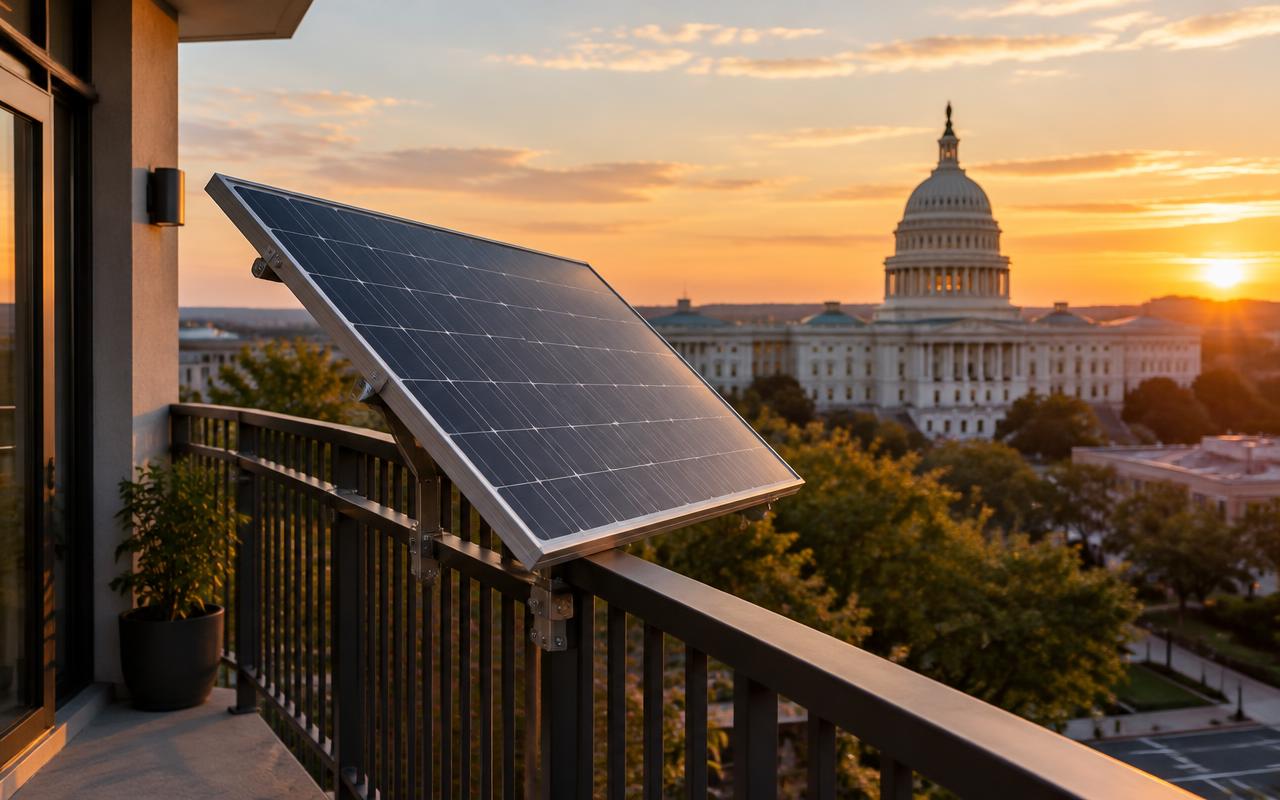
Every balcony solar story this year has been a state story. California legalized it. New Jersey legalized it. Utah, Colorado, Connecticut, New Hampshire followed. Each one its own bill, its own wattage cap, its own fight with utilities and HOAs. That changed on October 19, when Rep. Rob Menendez (D-NJ) introduced H.R. 10851 — the Socket Full of Sunshine Act — the first plug-in solar bill ever filed in Congress.
It's not law. It's not close to law. But it's the first sign that Washington is paying attention to a market that's grown almost entirely at the state level, and it's worth understanding what it would actually change if it ever got there.
What the bill would do
Strip away the name and the bill is really four things stapled together:
- Rebates. Up to $1,000 off a system's cost for low- and moderate-income households, funded through $100 million a year in Department of Energy grants to states, running 2027 through 2032. The catch: only kits with more than 55% U.S.-made parts by cost would qualify, and according to Bright Saver — the nonprofit that's been pushing plug-in solar bills state by state — no kit sold in the U.S. right now clears that bar.
- Renter protections, nationwide. States would have to stop landlords from banning plug-in solar outright for tenants who pay their own electric bill. Landlords could still restrict size and placement — a balcony railing panel is different from a sliding-door unit blocking a fire exit — but an outright ban would be off the table.
- A nudge, not a mandate, for utility rules. This is the part worth reading twice. The bill doesn't force any state to let plug-in systems skip interconnection agreements, utility approval, or extra fees. It requires every state utility commission to formally consider doing so, within one year of passage, and finish that process within two. States that already have a plug-in solar law, or voted on one in the last three years, are exempted — which covers most of the states that have moved fastest already.
- A real safety standard. The Consumer Product Safety Commission would write a national safety standard for these kits, and the FTC would create an EnergyGuide-style label — the same kind of sticker you see on a refrigerator — so buyers can compare savings claims without doing the math themselves. On specs, it lines up with where most state laws have already landed: 1,200 watts max, standard 120-volt outlet, National Electrical Code compliance, UL certification, with built-in power limiting required above 400 watts.
Why "consider" matters more than it sounds like
A federal law that only makes state regulators think about easing their rules isn't nothing, but it's also not the sweeping preemption some early headlines implied. New York's own plug-in solar bill, for comparison, is reportedly sitting on the governor's desk with Con Edison and National Grid lobbying against it — and that's the kind of fight this federal bill doesn't settle. It just sets a clock running in states that haven't had the fight yet.
The realistic timeline
Congress returns from recess in mid-November, and the current session ends January 3, 2027. Any bill not passed by then simply expires and has to be reintroduced from scratch. H.R. 10851 still needs a vote in the House Energy and Commerce Committee, then the full House, then a Senate companion bill that doesn't exist yet, then a presidential signature. Even the bill's supporters aren't predicting a vote this year — Bright Saver cofounder Cora Stryker called it "an incredible accelerant" for state-level momentum, which is a more honest description of its near-term impact than "the law changes soon."
What it means for you right now
Nothing changes today. If you're deciding whether to buy a plug-in system, the law that governs you is still whatever your own state has passed (or hasn't) — not this bill. What it does signal is that the federal rebate and interconnection fights that have played out state by state are now on Washington's radar, and that a $1,000 rebate and a national safety label are both plausible outcomes down the road, even if "down the road" means next Congress at the earliest.
Worth watching. Not worth waiting for. In the meantime, keep an eye on how your own state is moving on our Laws by State page.
See where plug-in solar stands in your state
Further Reading
- Socket Full of Sunshine Act: What the New Federal Plug-In Solar Bill Would Do — Solar.com
- Balcony solar bill introduced in Congress for the first time — Canary Media
- Bill calling for nationwide plug-in solar adoption introduced in Congress — Solar Power World
- New Jersey representative introduces first national plug-in solar legislation — pv magazine USA
Share this
Comments
Loading comments…
Leave a comment
Comments are reviewed before they appear.