
Balcony solar vs. rooftop solar: which one actually fits your home?
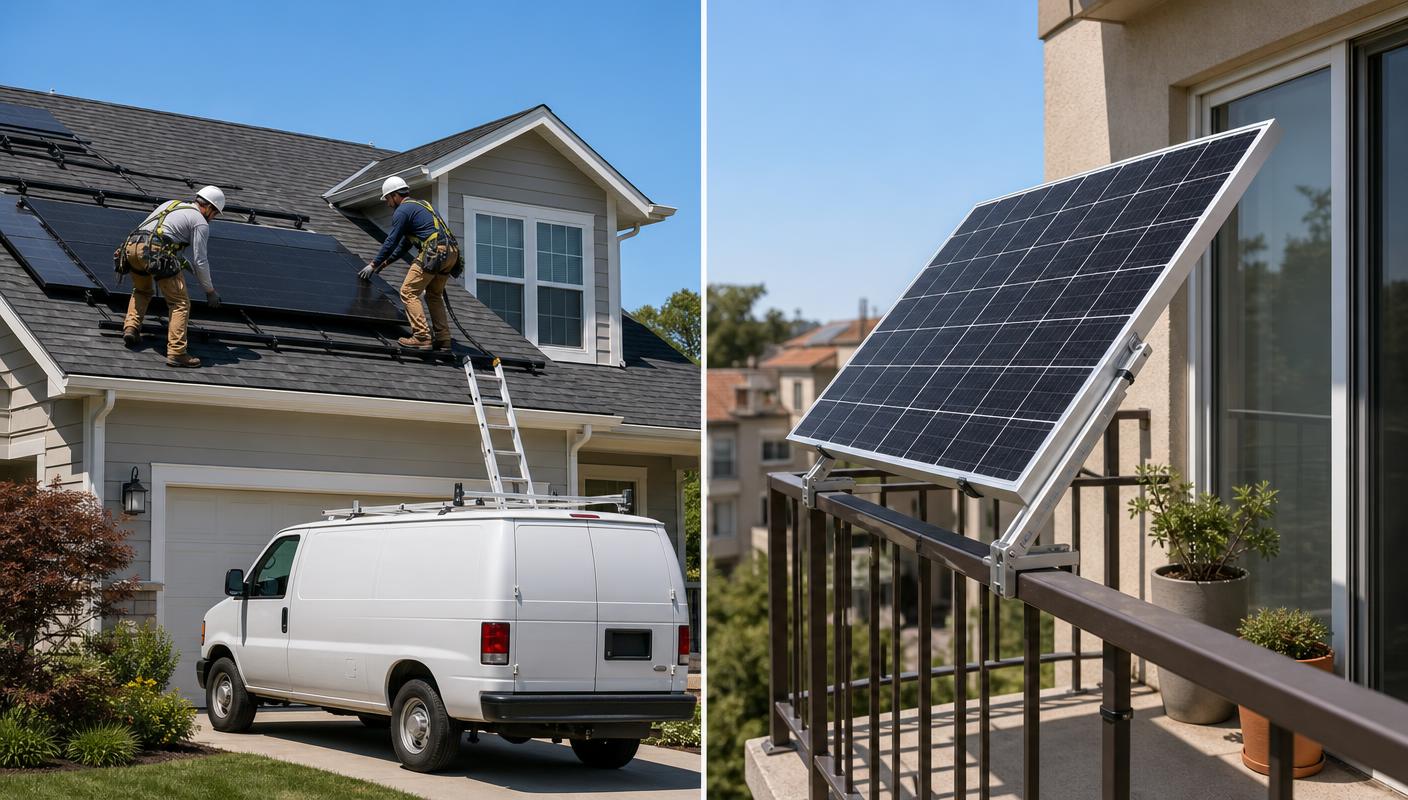
If you've started looking into home solar, you've probably run into two very different pitches. One is the traditional rooftop system: a contractor, a site survey, permits, a five-figure quote, and a 20-to-25-year relationship with your roof. The other is plug-in solar — sometimes called balcony solar — where a panel and a certified microinverter arrive in a box, mount to a railing or rack, and plug into a standard 110V outlet the same afternoon.
They are not competitors so much as different tools. Rooftop solar is built to cover most or all of a home's annual consumption. Plug-in solar is built to shave the always-on baseline load — the refrigerator, the router, the standby draw that runs 24 hours a day — with no permits, no installer, and no permanent modification. The right answer depends on what you own, what you're allowed to modify, how long you'll be there, and how much capital you want to commit up front.
Quick comparison
| Rooftop solar | Plug-in solar | |
|---|---|---|
| Cost | $15,000–$30,000 before incentives, usually financed | A few hundred to a few thousand dollars, paid once |
| Installation | Weeks of scheduling, permitting, and utility interconnection | Under an hour, done by you |
| Permits | Always required | None, in states that expressly allow it |
| Output | Can offset most of a home's usage | Offsets the baseline load and a slice of daytime consumption |
| Portability | Stays with the house | Goes in the car when you move |
| Who it fits | Long-term homeowners with good roof exposure | Renters, condo owners, apartment dwellers, and homeowners starting small |
Cost and commitment
The gap here is the single biggest reason plug-in solar exists. A typical residential rooftop system in the U.S. lands somewhere between $15,000 and $30,000 installed before the federal tax credit, and most buyers finance it — which means a loan, a lien question at resale, and interest that quietly extends the payback period. Even with incentives, the honest payback window is usually somewhere in the 8-to-15-year range depending on your rates and sun.
A plug-in kit is a purchase, not a project. There's no financing to arrange, no contractor deposit, no change orders. You buy the hardware, and the only ongoing cost is nothing. Because the up-front number is small, the payback math is dramatically simpler: divide what you paid by what you save each month.
Estimates based on a 1,200W solar system. Actual savings vary with sunlight, orientation, and local energy prices.
Installation and permitting
Rooftop solar is a construction project. It involves a site assessment, structural review, an electrical permit, an inspection, and a utility interconnection agreement before the system is allowed to produce a single watt. Timelines of two to four months from signature to switch-on are normal, and in some jurisdictions considerably longer.
Plug-in solar was designed to skip that entire pipeline. In the states that have passed dedicated legislation, a certified plug-in system below a defined wattage threshold is treated much like any other appliance: no permit, no inspection, no interconnection application. You mount the panel, plug in the microinverter, and it begins offsetting your load. The tradeoff is scale — these laws cap system size precisely because the exemption depends on the system being small enough to be inherently safe on a standard branch circuit.
How much power each one actually makes
A rooftop array is sized against your annual kWh consumption, and a well-designed one can offset the large majority of it. That's the whole point, and it's a real advantage if you own a house with unshaded south-facing roof area.
A plug-in system is sized against your baseline. Most homes draw a continuous 300–800 watts around the clock just keeping the lights on, the fridge cold, and the electronics awake. A plug-in kit aimed at that baseline runs during exactly the hours your utility charges the most, which is why the savings punch above the raw wattage. Pair it with a battery-equipped system like the EcoFlow STREAM Ultra and you can store midday production and discharge it during the evening peak — time-of-use arbitrage that a plain grid-tied rooftop array can't do without adding storage of its own.
Roof risk, moving, and reversibility
Rooftop mounting means penetrations through your roofing membrane. Done well by a reputable installer, that's a solved problem with a warranty behind it. But it does couple your solar system to your roof's remaining lifespan — if the roof needs replacing in eight years, the array comes off and goes back on at your expense. It also stays with the house when you sell, which may or may not be reflected in the sale price.
A plug-in system drills nothing. It clamps to a railing or sits on a ground rack, and it unclamps just as easily. If you move across town or across the country, it comes with you and keeps producing at the next address. For anyone who isn't certain they'll be in the same home for two decades, that reversibility is worth a great deal.
Renters, condos, and HOAs
This is the category rooftop solar simply cannot serve. If you rent, you don't own the roof. If you're in a condo, the roof is usually common property. Plug-in solar changes the equation because nothing permanent is installed — which is why several of the new state laws specifically address tenants and community associations, limiting a landlord's or HOA's ability to issue a blanket ban on a certified, properly mounted system. Check your lease and your association's rules before you buy, but know that the legal ground has shifted meaningfully in the last two years.
So which should you buy?
Choose rooftop solar if you own a single-family home with good sun exposure, plan to stay 10+ years, want to offset most of your consumption, and are comfortable committing five figures and a few months to get there.
Choose plug-in solar if you rent, live in an apartment or condo, want to start producing power this week, want the option of taking the system with you, or want to test the water before committing to a full rooftop install. Plenty of homeowners also run both: a plug-in kit is a perfectly sensible way to cover the baseline load now and decide about the roof later.
Sources & further reading
- Solar Energy Technologies Office — Homeowner's Guide to Going Solar — U.S. Department of Energy
- Residential Clean Energy Credit — Internal Revenue Service
- Solar Industry Research Data — Solar Energy Industries Association
- How much electricity does an American home use? — U.S. Energy Information Administration
- Balcony solar is coming to America — Canary Media
Share this
Comments
Loading comments…
Leave a comment
Comments are reviewed before they appear.